

Every summer, the coastal town of Puri in Odisha, India, transforms into a sea of sweeping human emotion. The air grows thick with the scent of burning camphor, wet earth, and crushed flowers. Millions of voices merge into a singular, rhythmic roar: “Jai Jagannath!”
This is the Rath Yatra—the Festival of Chariots. While India boasts countless grand festivals, the Rath Yatra holds a completely unique space in human spiritual history. It is not merely a celebration; it is a profound philosophical statement disguised as a spectacular, multi-million-person procession.
The Deity Who Steps Down from His Throne
In traditional temple frameworks, the deity is stationary. Seekers travel vast distances, queue for hours, and cross strictly managed thresholds just to catch a fleeting glimpse (darshan) of the divine.
But Lord Jagannath—affectionately known as the Lord of the Universe—upends this dynamic entirely.
Once a year, Jagannath, alongside his elder brother Balabhadra and younger sister Subhadra, leaves the dark, mysterious sanctum of the Shree Mandira. He steps out onto the dusty Grand Road (Bada Danda) to meet the world.
This act carries deep egalitarian significance. For centuries, various social segments, historically marginalized groups, and non-Hindu seekers were restricted from entering the main temple complex. By mounting the chariot, Lord Jagannath strips away every barrier of caste, creed, nationality, and economic status. If you cannot go to God, God will come to you.
Engineering the Ephemeral: Chariots Built from Scratch
The sheer scale of preparation for the festival is a marvel of ancient, sustainable engineering. The three massive chariots—Nandighosha (Jagannath), Taladhwaja (Balabhadra), and Darpadaliana (Subhadra)—are not preserved from year to year. They are built entirely from scratch every single spring.
The construction relies on centuries-old mathematical lineages passed down through families of royal carpenters (Maharanas). They use no modern blueprints, no metal nails, and no measuring tapes—relying instead on structural memory and body-length measurements like hands and fingers. Yet, every wheel aligns perfectly, and every axle bears the staggering weight smoothly.
The King with a Broom
Before the chariots can move, a striking ritual occurs that perfectly captures the soul of the Rath Yatra: the Chhera Pahanra. The Gajapati Maharaja—the titular King of Puri—arrives in a palanquin. He does not step forward to assert his royal authority; instead, he takes a gold-handled broom and sweeps the dust and dried flowers off the tracks directly in front of the chariots, sprinkling them with fragrant sandalwood water.
The Tug of Destiny
Once the tracks are clear, the pulling begins. Massive, thick ropes woven from coconut fiber are gripped by thousands of hands simultaneously.
To pull the rope of Jagannath’s chariot is considered one of the most auspicious acts in a lifetime. As the massive wooden structures creak and groan forward, the energy is chaotic yet deeply unified. Total strangers sweat, strain, and lean into each other. If someone falls, ten hands immediately reach out to pull them back up.
The journey spans roughly three kilometers along the Grand Road toward the Gundicha Temple, their aunt’s house, where the deities rest for nine days. It is a slow, rhythmic crawl that mirrors the human journey through life—halting, strenuous, but beautiful when moving forward together.
The Bitter-Sweet Sweetness of Poda Pitha
No festival is complete without its flavors, and the Rath Yatra is tied directly to the unique culinary heritage of Odisha. During their return journey (Bahuda Yatra), the chariots halt at the Mausi Maa Temple. Here, the deities are offered Poda Pitha—a slow-baked, slightly burnt rice and lentil cake sweetened with jaggery, grated coconut, and spiced with cardamom. It is a rustic, comforting food that feels distinctly like home.
Echoes in the City of Lakes: Udaipur’s Jagdish Mandir
While Puri remains the epicenter, the spiritual gravity of the Rath Yatra pulls hearts thousands of miles away into the royal state of Rajasthan. In the historic city of Udaipur, the festival takes on a breathtaking, distinctly Mewari grandeur centered around the iconic Jagdish Mandir.
Rising proudly above the city skyline, this 17th-century Indo-Aryan temple becomes the launching pad for Western India’s most massive chariot procession.
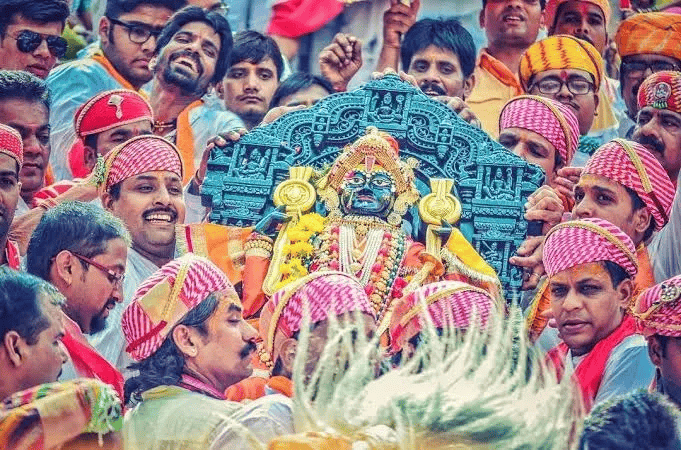
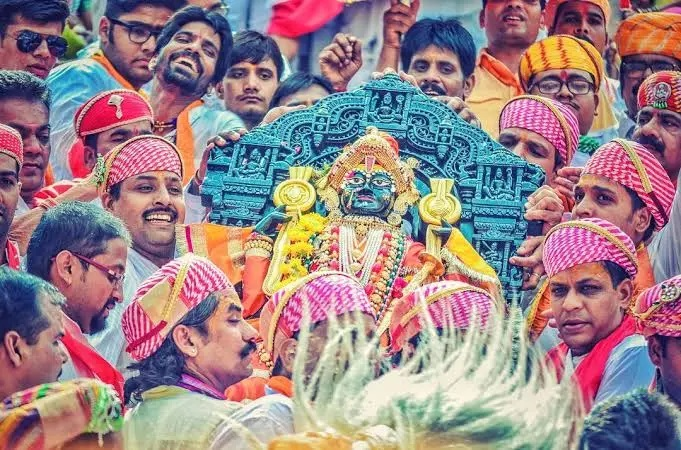
Here, the Lord of the Universe is affectionately worshipped as Thakurji. Instead of the massive wooden giants of Odisha, Udaipur’s procession features a magnificent, intricately carved silver chariot. As the deity descends the steep stone stairs of Jagdish Mandir to meet the citizens, the narrow, winding alleys of the old city explode into a kaleidoscope of saffron flags, traditional folk music, and Mevadi turbans.
Local merchant guilds, youth groups, and royal descendants unite to pull the silver chariot through the historic gates, proving that whether on the coastal sands of Puri or amidst the lakes of Rajasthan, the message remains identical: divine grace belongs to everyone.
A Global Resonance
What started centuries ago on the eastern coast of India has now spilled over every geographical boundary. Today, Rath Yatras are celebrated on the streets of London, New York, Moscow, and Sydney. The image of the giant colorful canopy moving past skyscrapers is a reminder of a timeless truth: human devotion speaks a universal language.
The Jagannath Rath Yatra teaches us that spirituality isn’t meant to be locked behind closed doors. It belongs in the streets, in the dust, in the collective sweat of communities helping one another move forward. It is a celebration of movement, equality, and the beautiful idea that the divine is always willing to walk alongside us.