
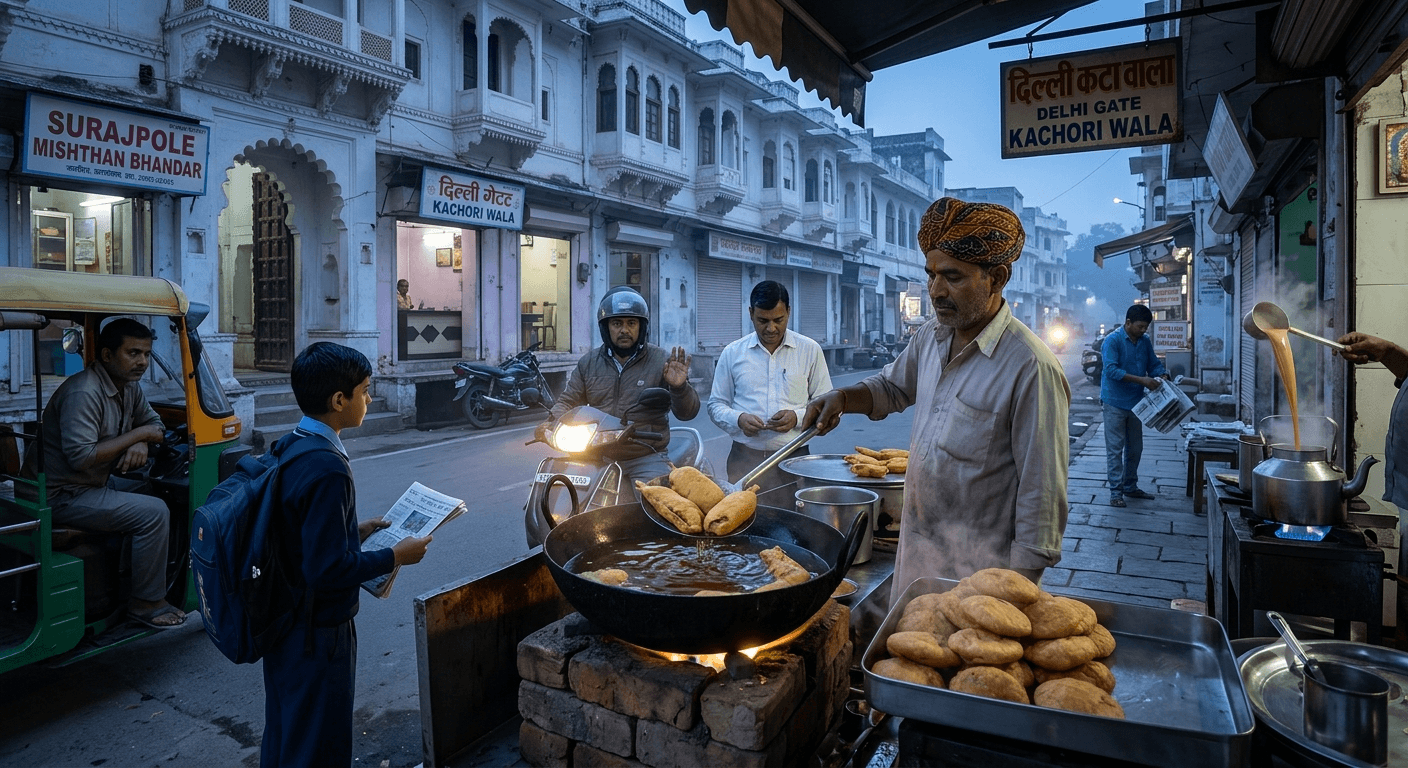

Breakfast in Udaipur unfolds outdoors, shaped by the heat of fryers and boiling kettles. Around Shastri Circle and the turns leading to Delhi Gate, Surajpole, and up to Jagdish Chowk, morning routines take shape before the sun clears the whitewashed rooftops.
The rhythm follows the city’s working day. Vegetable vendors, milk suppliers, shopkeepers, and office commuters are already on the streets before sunrise, so breakfast stalls are busiest between 6:30 and 8:30 a.m. By the time many visitors are just leaving their hotels, the morning rush has already begun to fade.
When the clock hits 6:30 in the morning, along the road near Delhi Gate, Surajpole, and Shastri Circle, the air still holds the cool dampness of the lakes. The sizzle of frying batter fills the morning air.. A two-wheeler rider skids to a quiet halt beside a deep iron kadhai set on a low brick burner. The rider does not bother turning off his engine; he holds up two fingers to the man behind the counter. Without breaking his rhythm, the halwai lowers a pair of long green chillies—stuffed with spiced potato and coated in thick gram flour batter—into oil that ripples gently around the edges. The snack is known locally as Mirchi Bada.
By seven, crowds gather without any formal queue. An auto-rickshaw driver resting his forearm on his handlebar waits beside a bank clerk in an ironed white shirt. A schoolboy in a navy uniform shifts his backpack from one shoulder to the other, watching a halwai lift Pyaz Kachoris from the oil with a long slotted skimmer, holding them over the pan for a few seconds to drain before tipping them onto squares of cut newsprint.
A few meters away, a newspaper vendor drops a bound bundle of dailies onto the stone pavement. The thud briefly cuts through the steady sound of brass ladles scraping against wide aluminum trays.
The Mirchi Bada here is practical and substantial. The green chilli, slit down the center and seeded, softens slightly under the crisp batter while retaining enough structure to hold the filling—a potato mash seasoned with crushed coriander seeds, amchur, and coarse salt. Beside it, the Pyaz Kachori crackles when pressed lightly. Inside, the filling of coarsely chopped red onions, fennel, and black pepper releases a small plume of steam as the crust breaks.
No one asks for cutlery. You break off a piece with your fingers, scoop up a bit of mint-coriander chutney or dark tamarind sauce dipped from stainless steel bowls, and eat while standing near the curb. Traffic slows slightly around this breakfast corner as the scooter parked slightly too far into the narrow lane forces passing milkmen and newspaper vendors to veer around the crowd, but nobody pays much attention.
At an adjoining tea stall, a metal kettle hums continuously over a blue flame. Every few minutes, the tea boils up near the rim, only to be calmed when the vendor scoops up a ladleful and cascades it back into the kettle from a foot above. A customer standing near the counter finishes his last bite of kachori, wipes a speck of chutney from his thumb with a paper napkin, and leaves a coin on the wooden counter before taking his small glass of hot chai.
By nine, the sun lights up the storefronts directly. The heavy early-morning rush thins as offices and schools settle into the day, leaving behind grease marks on paper plates in the bins and the faint, sweet scent of frying dough lingering in the warming air. The halwai wipes his flour-dusted hands on a cloth tucked into his apron, adjusts the flame beneath the oil, and begins prepping the potato mixture for the mid-morning crowd.