
Before Udaipur became a regular stop on luxury itineraries and Instagram feeds, it was simply a city where people went about their day at an easy pace. The Aravalli hills framed everyday life; the lakes set the rhythm, and very little felt hurried.
Traffic was light enough that the sound of a passing Ambassador or Jeep drew attention. News spread from one neighborhood to another without phones or group chats. Children disappeared into the streets after school and came home when the evening grew dark. Outside small teashops, conversations wandered from local politics to cricket scores, with the history of Mewar never too far away.
That slower pace shaped the city as much as its palaces did.
Lake Pichola and Fateh Sagar were not places people visited. They were part of ordinary life.
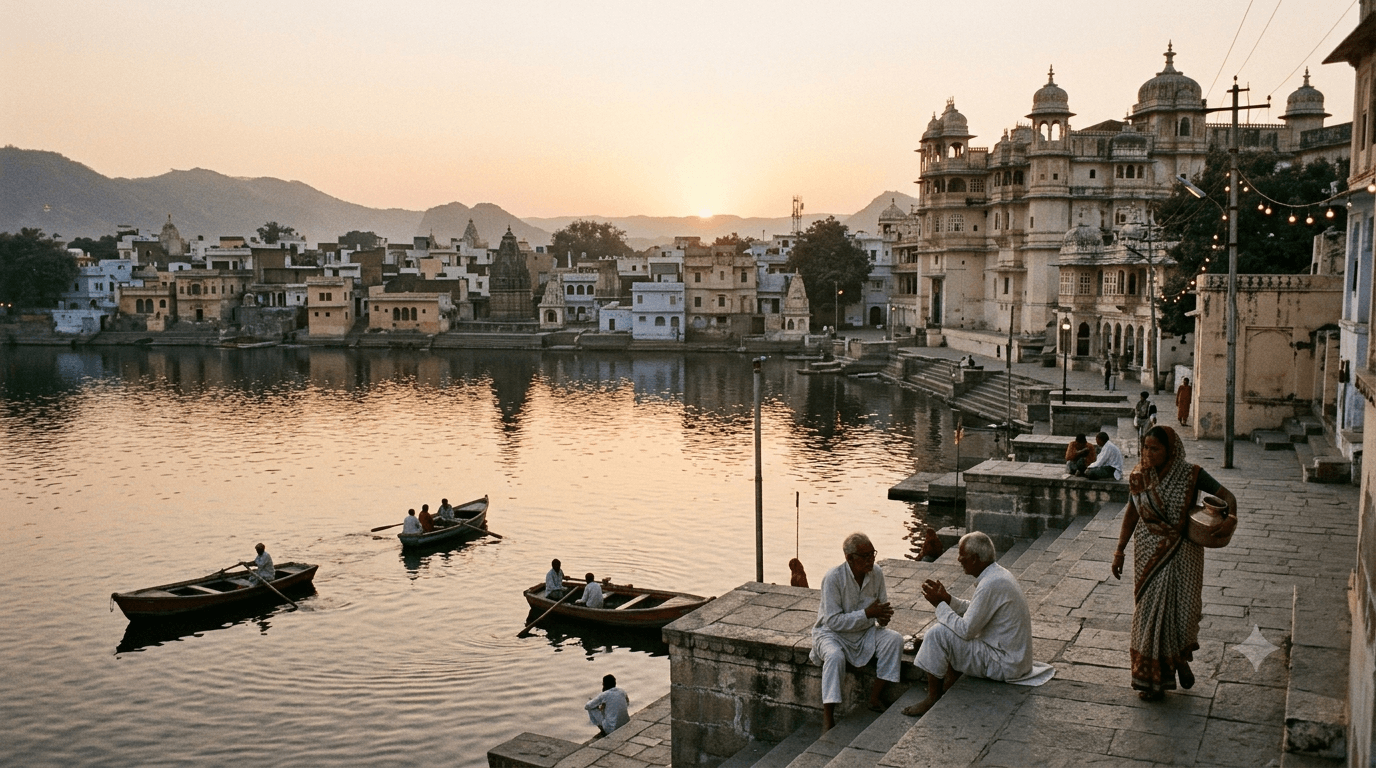
Early mornings at Lake Pichola began before the day warmed up. Priests performed rituals on the Ghats, the first boats crossed the water, and the bells from nearby temples carried across the lake. The City Palace reflected on the surface before the wind disturbed it. Residents walked along the waterfront because it was their daily routine—not because it made a good photograph.
The Ghats were busy in practical ways. People came with brass and steel vessels, fishermen prepared their boats, and boatmen ferried local passengers across the lake long before sightseeing cruises became the norm.
Fateh Sagar had its own character.
As the sun dropped behind the hills, families gathered along the promenade. Vendors sold roasted peanuts and ice cream, children leaned against the railing to watch the water, and people stayed for the breeze more than anything else. Nobody worried about finding the best angle for a picture. Sitting beside the lake for an hour was reason enough to come.
Udaipur’s story reaches much further back than its lakeside evenings.
In 1559, Maharana Udai Singh II established the city after repeated attacks on Chittorgarh made it necessary to move the capital of Mewar into the natural protection of the surrounding hills. The decision changed the course of the kingdom’s history. From here, the rulers of Mewar continued a tradition of resisting outside powers while preserving their independence for generations.
No name is remembered more than Maharana Pratap.
His refusal to accept Mughal rule remains central to Rajasthan’s history, and in Udaipur his story has never been confined to textbooks. It has long been passed down at home, repeated in classrooms, and retold during family gatherings. For many residents, these were not distant historical figures. They were part of the city’s identity.
The City Palace stands as the clearest record of that history.
Over nearly four centuries, successive Maharanas expanded the palace into the vast complex seen today. Courtyards lead into narrow passages. Marble balconies overlook Lake Pichola. Colored glass catches the afternoon light, and carved gateways open onto terraces with views across the old city.
Years ago, the palace felt noticeably quieter. Visitors moved through its galleries without queues stretching across the courtyards or phones raised at every turn. The building invited people to look closely—at the stonework, the painted walls, the details that reveal how each ruler added another layer to the palace.
Step outside, and the old city unfolded in a maze of narrow lanes.
Shops displayed silver jewellery, miniature paintings, leather mojris, and hand-printed textiles. Spice merchants filled the air with the smell of red chilli, coriander, and cumin. Kachoris disappeared from hot oil into paper packets, and familiar customers stopped to exchange a few words before heading home. Shopkeepers often knew the families they served.
There was no rush to finish a conversation.
Looking back, what stands out is not only the architecture or the lakes. It is the pace of everyday life. People noticed things because they were not constantly moving—a kingfisher skimming the water, the afternoon light climbing the palace walls, the quiet that settled over the city once the markets closed.
Udaipur has changed, as every growing city does.
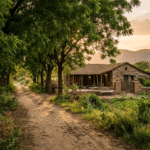
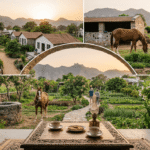
Hotels have multiplied, traffic is heavier, and visitors arrive throughout the year. Around Lake Pichola and Fateh Sagar, cafés, boutique stays, and farm stays now share space with buildings that have stood for centuries. Over the past few years, farm stays on the city’s outskirts—towards Badi, Sisarma, Nai, and the Gogunda road—have become especially popular. Many travelers now look for open fields, private villas, and a quieter setting after spending the day exploring the old city, making these countryside retreats one of the fastest-growing parts of Udaipur’s hospitality scene.
Yet parts of the older city still keep their familiar rhythm.
Walk around Lake Pichola at sunrise before the tour boats begin operating, and the water is often calm enough to mirror the palace. Temple bells still carry through the morning air. In the old neighborhoods, longtime residents sit outside their homes, talking about families, festivals, and the Udaipur they remember. The city has grown. Its quieter corners have not disappeared—you simply have to arrive early enough to notice them.